If you are trying to understand Chevy Chase real estate, one of the biggest mistakes you can make is treating it like a single neighborhood. In reality, Chevy Chase is a collection of small, closely connected micro-markets, and that is why two homes just a few blocks apart can have very different price points, buyer demand, and renovation potential. If you are buying or selling here, it helps to know how housing style, municipal boundaries, and local rules shape value. Let’s dive in.
Why Chevy Chase Feels So Different Block to Block
Chevy Chase is not one uniform market. Montgomery County lists places like Chevy Chase Village, the Town of Chevy Chase, Section Three, Section Five, Martin’s Additions, North Chevy Chase, Chevy Chase View, and Somerset as separate municipalities, while the broader Chevy Chase census-designated area includes additional mixed-use and multifamily housing.
That fragmentation matters in real life. When you hear "Chevy Chase," you may be talking about a historic village of detached prewar homes, a quieter postwar pocket, or a condo-heavy edge near Bethesda and Friendship Heights. Those differences affect pricing, competition, and what buyers expect from a property.
Chevy Chase Housing Stock at a Glance
In the broader Chevy Chase CDP, 66.7% of homes are 1-unit detached, 25.0% are in buildings with 20 or more units, and 75.9% of occupied homes are owner-occupied. The median home value in the 2020-2024 American Community Survey was $1,245,000.
That top-line data is useful, but it only tells part of the story. The detached-home villages are very different from the condo and multifamily pockets, and those segments do not always move the same way in the market.
Older Detached Homes Shape the Core Market
Many of Chevy Chase’s core municipalities are defined by older detached housing. The Town of Chevy Chase is 100% detached in the ACS, with 66.7% of homes built in 1939 or earlier. Chevy Chase Village is also entirely detached, with 64.9% of homes built before 1940.
Section Three is 100% detached and 81.3% pre-1940, while Section Five is 91.0% detached with 60.6% built before 1940. North Chevy Chase is also heavily detached at 98.2%, but it has more postwar housing and a large share of 1950s construction, which gives it a different feel from the older villages farther south.
For buyers, this means much of Chevy Chase’s value is tied to detached homes in low-turnover neighborhoods. For sellers, it means exact lot size, frontage, updates, and block location can carry more weight here than in a more uniform suburban market.
The Main Chevy Chase Housing Styles
Chevy Chase Village and the broader streetcar-era core developed roughly between 1892 and 1930. According to the National Park Service historic-district study, the area includes strong concentrations of Colonial Revival, Neoclassical, Shingle, Tudor Revival, Italian Renaissance, and Craftsman homes.
These styles are not just architectural labels. In Chevy Chase, they often signal the kind of lot a home sits on, the likely buyer pool, and how much flexibility an owner may have for renovation or expansion.
Colonial Revival and Center-Hall Colonials
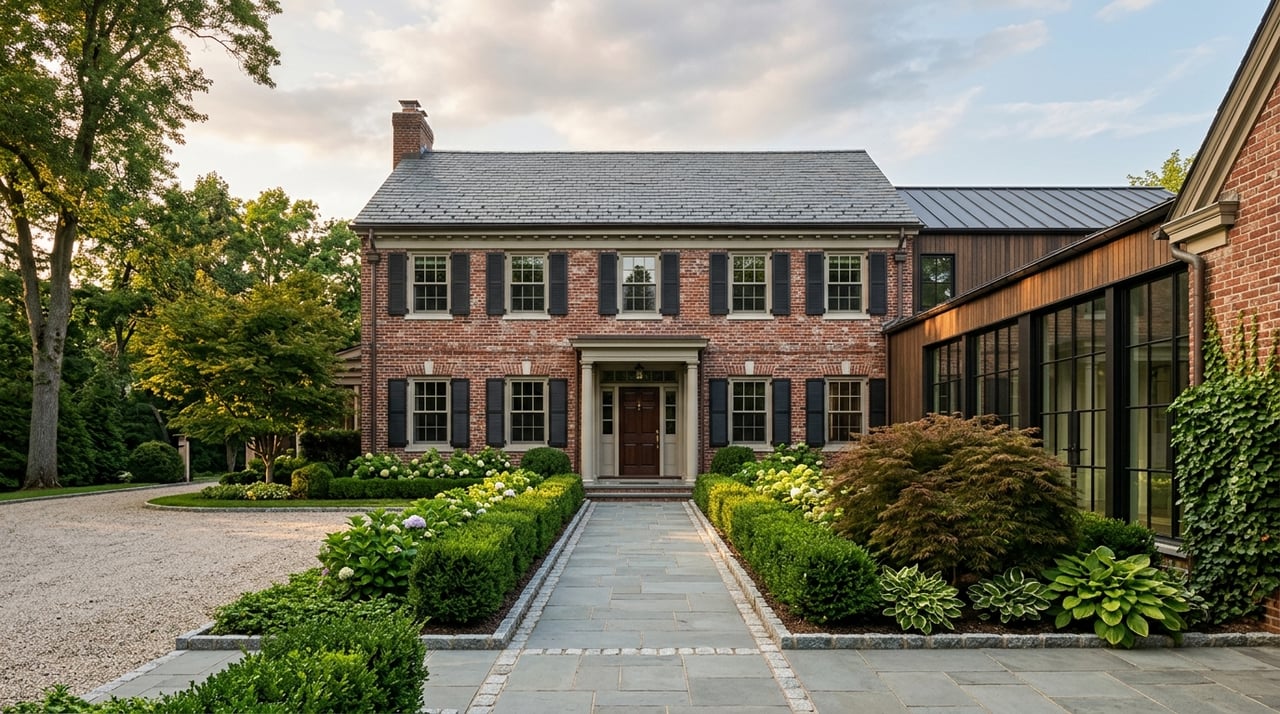
Classic Colonial Revival and center-hall Colonial homes are closely tied to the older detached-house villages and the Town of Chevy Chase. These homes often reflect formal prewar design, established streetscapes, and lot-driven value.
If you are shopping in this category, you are usually evaluating more than square footage. Buyers often compare original character, renovation quality, and how well additions or updates fit the home’s architectural fabric.
Cottages, Bungalows, and Foursquares
Earlier streetcar-era homes also include smaller cottages, bungalows, and foursquares. These homes often appeal to buyers looking for charm, practical lot use, and walkability rather than maximum scale.
In market terms, these properties can be especially sensitive to layout, condition, and expansion potential. A well-updated smaller home in the right location may attract strong demand even when it competes with larger properties nearby.
Newer Construction and Major Rebuilds
Newer construction and substantial rebuilds tend to appear where lot conditions and local review standards make expansion more feasible. In the historic core, that supply is naturally more limited because design review and permitting can affect what is possible.
That is one reason newer or extensively rebuilt homes can stand out so much in Chevy Chase. They may offer the scale and modern layouts some buyers want, but availability depends heavily on the exact municipality and lot constraints.
Townhomes and Condos
Townhomes and condos operate as a separate asset class in the broader Chevy Chase market. This is especially true along the Bethesda and Friendship Heights edge, where urban-style housing and lower-value pockets sit beside much more expensive detached-home enclaves.
If you are comparing a condo near the commercial edge to a detached house in one of the villages, you are really comparing two different markets. That is why broad averages can be misleading without local context.
Micro-Markets to Know in Chevy Chase
Chevy Chase Village
Chevy Chase Village is one of the most historically intact parts of the area and one of the highest-valued. Zillow’s neighborhood data placed its typical value around $2,408,035, well above the broader Chevy Chase average.
The historic-district study describes it as the county’s first and most influential streetcar suburb and one of the region’s most intact pre-World War II suburban ensembles. For buyers and sellers, that historic character is a major part of the appeal, but it also means visible front and side changes may face more scrutiny than rear alterations.
Town of Chevy Chase
The Town of Chevy Chase is a separate municipality with its own boundaries and development history. Town materials describe its boundaries as roughly East-West Highway to Bradley Lane and Connecticut Avenue to one block east of Wisconsin Avenue, with about 1,032 homes and roughly 3,000 residents.
Its development accelerated after World War I, which helps explain why its housing stock can feel somewhat later and more uniform than the oldest blocks near the historic village core. That difference can matter when buyers compare streetscape, lot rhythm, and renovation expectations.
Section Three and Section Five
Section Three and Section Five are small, but they matter because local rules can have a real effect on redevelopment potential. Section Three has 267 housing units, all detached, and its rules include a 30-foot front setback, 20-foot rear setback, and 8-foot side setbacks. Its village materials also note that the streets are extremely narrow.
Section Five has 279 housing units, 91.0% detached, and building regulations that supersede Montgomery County rules. In practical terms, these types of constraints can shape whether a renovation feels straightforward or highly limited, which can directly affect buyer interest and pricing.
Martin’s Additions
Martin’s Additions tends to behave like its own walkable pocket rather than a generic extension of Chevy Chase. It has early-20th-century suburban roots and, based on Zillow neighborhood data, a typical value around $1.67 million.
That places it below Chevy Chase Village but still comfortably above the broader Chevy Chase average. For many buyers, Martin’s Additions offers a distinct blend of neighborhood identity, detached housing, and strong pricing support.
North Chevy Chase
North Chevy Chase is a smaller village near the Beltway with 211 single-family dwellings in just 0.11 square miles. Its housing stock is still overwhelmingly detached, but its larger share of 1950s-era homes gives it a more postwar profile than the older prewar villages.
That difference matters when you think about layout, lot use, and renovation style. A buyer drawn to original 1920s or 1930s architecture may respond differently here than a buyer who prefers a more mid-century or postwar starting point.
Condo and Urban-Edge Pockets
The broader Chevy Chase search area also includes condo-heavy or urban-edge pockets with much lower pricing than the detached villages. Zillow’s neighborhood list within Chevy Chase includes places like Pearl District, Bethesda Center, Wisconsin North, and Bethesda Row at price levels far below the detached-home enclaves.
This wide spread is one of the clearest reminders that “Chevy Chase” is not one pricing tier. If you are buying, selling, or pricing a home, you need to know which submarket you are actually in.
What Market Signals Are Saying
As of spring 2026, Zillow’s broad Chevy Chase page showed a typical home value of $1,255,658, down 1.4% year over year, with 101 homes for sale, 44 new listings, a median sale price of $1,247,369, and homes going pending in about 12 days. Realtor.com’s Chevy Chase page showed 53 homes for sale, a median listing price of $1.25M, average days on market of 37, and a 99% sale-to-list ratio.
The numbers differ because the platforms use different geographies and timing windows, but the bigger message is consistent. Chevy Chase remains a premium-priced market with relatively tight conditions, and buyers and sellers still need to pay close attention to micro-location.
Why Street-Level Analysis Matters Here
In smaller municipalities like Section Three, Section Five, Martin’s Additions, and North Chevy Chase, a single standout sale can influence neighborhood-level stats more than it would in a much larger suburb. That makes broad median numbers less reliable on their own.
Public sales also show how much lot, condition, and renovation quality matter. In Section Five, several 2026 closings were reported in roughly the $1.5 million to $2.65 million range, while homes in Somerset have also shown mid-$1 million examples. Those are meaningful differences within the same broader Chevy Chase conversation.
What Buyers Should Watch
If you are buying in Chevy Chase, look beyond the name of the neighborhood and focus on the exact micro-market. Start with these questions:
- Is the home in a separate municipality with its own rules?
- Is the value driven mostly by architecture, lot size, or recent renovation?
- Does the block consist mainly of prewar detached homes or a more mixed housing pattern?
- Are expansion or exterior changes likely to be straightforward or more constrained?
- Are you comparing detached homes to condos or townhomes that behave differently in the market?
The more specific your analysis, the better your decision-making will be. In Chevy Chase, small differences often have an outsized effect on long-term value and day-to-day livability.
What Sellers Should Watch
If you are selling, pricing and presentation should reflect your exact submarket, not just the broader Chevy Chase label. A detached prewar home in a tightly held village should not be positioned the same way as a condo on the edge of Bethesda or a postwar house in a different municipal setting.
This is also a market where design choices and renovation quality can strongly influence buyer response. When housing styles are older and architecture carries meaning, buyers tend to notice whether updates feel thoughtful, cohesive, and appropriate for the home and lot.
The Bottom Line on Chevy Chase
Chevy Chase rewards careful local analysis. Its housing stock is heavily detached, often older, and shaped by small municipalities that can have very different histories, rules, and buyer expectations.
If you understand the housing style, the municipal context, and the exact block-level market, you are in a much stronger position whether you are buying, selling, or weighing renovation potential. For tailored guidance on Chevy Chase and the broader upper DMV market, connect with Mandana Tavakoli.
FAQs
What makes Chevy Chase, MD a micro-market area?
- Chevy Chase includes several separate municipalities and subareas, such as Chevy Chase Village, the Town of Chevy Chase, Section Three, Section Five, Martin’s Additions, North Chevy Chase, and condo-heavy edge pockets, so pricing and housing character can vary sharply by location.
What housing styles are common in Chevy Chase, MD?
- Common styles in the older core include Colonial Revival, Neoclassical, Shingle, Tudor Revival, Italian Renaissance, Craftsman, and smaller streetcar-era cottages, bungalows, and foursquares.
How much of Chevy Chase, MD is detached housing?
- In the broader Chevy Chase CDP, 66.7% of housing units are 1-unit detached, while several core municipalities such as the Town of Chevy Chase and Chevy Chase Village are entirely detached in the ACS profiles.
Why do home prices vary so much within Chevy Chase, MD?
- Prices vary because housing type, lot size, renovation quality, municipal rules, historic character, and exact block location all differ across Chevy Chase’s small submarkets.
Are condos and detached homes in Chevy Chase, MD part of the same market?
- Not really. Condos and townhomes, especially near Bethesda and Friendship Heights, often behave as a separate market segment from the detached-home villages.
What should buyers ask before purchasing in Chevy Chase, MD?
- Buyers should ask about the home’s municipality, age, architectural style, lot constraints, renovation history, and whether local rules may affect future additions or exterior changes.